

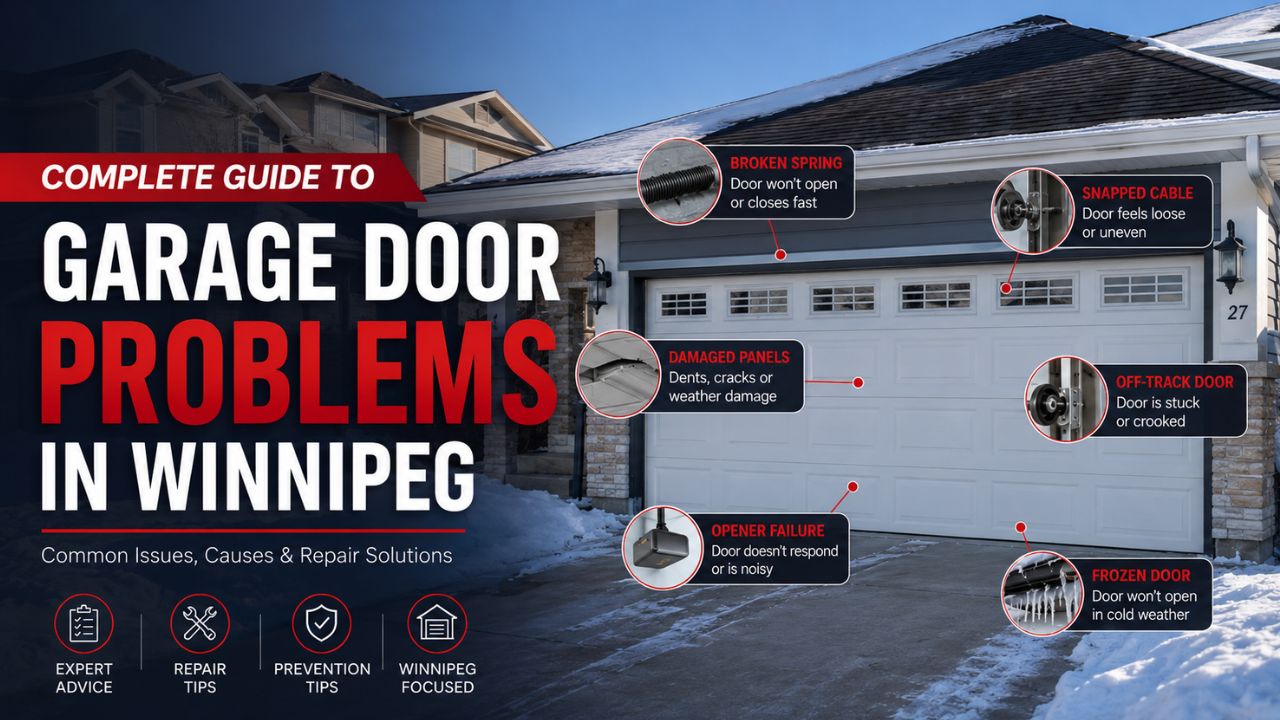
If you live in Winnipeg, you already know what your garage door goes through every year. We get winters that push down to -35 or colder, spring melt that floods garage floors, and summer storms that bring hail and wind. Your door opens and closes roughly 1,500 times a year and takes the full force of all of it.
Most garage door problems we see in Winnipeg are not random. They follow patterns. Springs break more often in January and February because the cold makes the metal brittle. Bottom seals freeze to the concrete overnight when temperatures drop fast. Cables corrode faster because of the road salt that tracks in on vehicles all winter.
This guide covers every major garage door problem we deal with here in Winnipeg. What causes it, how to spot it early, what you can safely handle yourself, and when you need to call a technician. We have put it in order from the most urgent safety issues to the smaller things you can deal with over time.
About A1 Plus Doors: We are a family-owned garage door company based in Winnipeg. We serve homes and businesses across the city, from River Heights and St. Vital to West Kildonan and Transcona. Everything in this guide comes from years of actual service calls in this city.
Quick Reference: What Is Wrong With My Garage Door?
Find your symptom in the table below and jump to the right section.
| What You Are Seeing | Most Likely Cause | DIY Safe? | How Urgent |
|---|---|---|---|
| Door will not open or close at all | Broken spring or snapped cable | No – call a tech | Urgent |
| Loud bang from inside the garage | Spring just broke | No – stop using door | Urgent |
| One side hangs lower than the other | Cable off drum or broken spring | No – call a tech | Urgent |
| Door opens a few inches then stops | Opener safety tripped due to spring failure | No – call a tech | Urgent |
| Door opens partway then reverses | Safety sensor blocked or off-axis | Check sensor first | Medium |
| Door is frozen to the ground | Ice seal – Winnipeg winter problem | Yes, carefully | Medium |
| Door is slow or straining | Worn rollers, dirty tracks, or opener issue | Lubricate first | Low |
| Squeaking or grinding noise | Dry rollers or hinges | Yes – lubricate | Low |
| Rattling while moving | Loose bolts or worn rollers | Tighten hardware first | Low |
| Remote does not work, wall button does | Dead battery or antenna issue | Replace battery first | Low |
| Panels are dented or cracked | Impact damage | Cosmetic repair possible | Low to Medium |
Broken or Worn Garage Door Springs
Broken springs are the number one repair we do in Winnipeg. They are also the most dangerous problem on this list. A torsion spring holds enormous tension and when it snaps, it releases that energy instantly. This is not a repair to try yourself.
What springs actually do
Your garage door weighs anywhere from 90 to 200 kilograms depending on the material and how much insulation it has. The springs counterbalance that weight so your opener motor only has to do a small amount of work to move the door. When a spring fails, the opener is suddenly pulling the full weight of the door on its own. Most motors will burn out within weeks under that load.
How to tell if a spring has broken
- You heard a loud bang from inside the garage, like something fell or a gun went off. That is the spring snapping.
- The door will not open, or it only opens about six inches before the opener stops.
- When you lift the door manually, it feels extremely heavy, almost impossible to hold up.
- One side of the door rises faster than the other or the door looks crooked in the frame.
- You can see a gap or separation in the coil of the spring above the door.
Why Winnipeg winters are especially rough on springs
Steel gets brittle in the cold. Winnipeg regularly sees -20 and colder for weeks at a time, and during bad stretches, -35 or below. Every time your garage door cycles, the spring goes through expansion and contraction along with the temperature. Most springs are rated for 10,000 to 25,000 cycles. In a Winnipeg climate, that lifespan is shorter than what manufacturers estimate based on milder conditions.
We see the most spring failures in January and February. If your springs are past the seven-year mark, having them replaced before winter is worth it rather than waiting for the failure.
Important safety note: Do not try to open the door manually if you think a spring is broken. The door could drop suddenly without warning. Pull the red emergency cord to disconnect the opener and leave the door where it is until a technician arrives.
Snapped or Frayed Garage Door Cables
Cables work with the springs to lift and lower the door evenly. When one snaps, the door drops on that side and puts enormous strain on the other cable, the tracks, and the opener. In a worst case the whole door can come down fast.
Signs your cables are failing
- One side of the door is lower than the other when it moves.
- You can see a loose wire or cable coiled on the ground near the bottom corner of the door.
- The door drags or scrapes on one side of the track.
- The door closes with a hard thud on one side instead of sitting level.
What causes cable failures in Winnipeg
Cables wear from constant friction and tension over thousands of cycles. In Winnipeg, road salt is a big factor. It tracks in on vehicles all winter and sits on the garage floor. Over time that salt causes corrosion on the cable where it meets the bottom bracket and drum. A cable can look fine from the outside while the inner strands are already compromised.
One breaks, replace both: If one cable snaps, the other is almost always at a similar point in its wear cycle. We always replace both at the same time. Replacing just one means the second is likely to fail within weeks.
Garage Door Off Track
A door that has jumped its tracks will hang at an angle and should not be operated until a technician looks at it. Running the opener against an off-track door will burn out the motor and can cause the door to fall.
What causes a door to come off track
- A cable snapped and the door lifted unevenly, forcing it out of the track.
- A vehicle or object hit the door while it was moving or closed.
- Rollers wore down to the point they can no longer grip the track properly.
- A section of track got bent from years of minor impacts and the roller eventually popped out.
- Track mounting bolts came loose over time and the track shifted out of position.
Can you put a door back on track yourself?
Sometimes. If the door came off track because of a single worn roller and the tracks themselves are straight and undamaged, some homeowners can guide it back. But if a cable snapped, if the tracks are bent, or if more than one roller is involved, that is a job for a technician. Forcing a door back onto a bent track makes everything worse.
Garage Door Frozen to the Ground
This one is almost unique to Winnipeg and cities like ours. What happens is snow or meltwater gets under the door, and then temperatures drop overnight and freeze the bottom seal directly to the concrete. When you hit the opener button in the morning, the motor strains against a door that is stuck solid. That stress can snap a spring or strip the opener drive in one go.
How to safely free a frozen door
- Hit the stop button right away if you hear the opener straining. Do not let it keep running.
- Pour warm water, not boiling, along the bottom seal to melt the ice underneath.
- A heat gun or hair dryer run slowly along the seal will also work. Do not hold it in one spot.
- Once the seal has softened, a plastic scraper can help separate it from the concrete.
- After the door is free, dry the floor along the seal line and apply a silicone-based lubricant to the seal to help prevent it from sticking again.
How to stop it from happening every winter
If your door freezes regularly, the bottom seal has probably hardened and cracked from years of cold weather cycling. A cracked or rigid seal cannot compress properly and water gets under it easily. We carry cold-weather seals that stay flexible down to -40. When we do fall maintenance visits, checking and replacing the bottom seal is one of the first things we look at.
Garage Door Opener Not Working
Opener calls are some of the most common we get, and they are also the category where homeowners can do the most useful troubleshooting on their own before calling anyone.
Check these things first before calling a technician
- Dead remote battery: This is the cause roughly a third of the time. Replace the battery and try again.
- Power to the unit: Make sure the opener is plugged in and the outlet has power. Test the outlet with another device.
- Safety sensors: Look at the two small sensors sitting at the bottom of each side of the door frame. Both lights should be steady, not blinking. If one is blinking, the sensors are out of alignment or something is blocking the beam. Wipe the lenses clean and gently nudge the sensor back into position.
- Antenna: The antenna wire hanging from the opener should point straight down. If it got pushed up against the ceiling it will lose range.
- Travel limits: If the door reverses before fully closing or stops before fully opening, the travel limit adjustment screws on the opener may need a small turn. Check your opener manual for the limit adjustment location.
When the opener itself is the problem
If you can hear the motor running but the door does not move, or if you hear a grinding noise from the opener unit, the drive mechanism is likely stripped. Chain and belt drive openers have a drive gear that wears out after years of use. That gear can be replaced on most models, or if the opener is more than 15 years old, a full replacement often makes more sense.
Noisy Garage Door: What Each Sound Means
A noisy door is worth paying attention to. Different sounds point to different problems and some of them are early warnings of something that will eventually need a repair call.
| Sound | Where It Is Coming From | What to Do First |
|---|---|---|
| Squeaking | Dry rollers or hinges | Lubricate with white lithium grease or silicone spray |
| Grinding | Worn rollers or metal-on-metal track contact | Inspect rollers; may need replacement |
| Rattling | Loose nuts, bolts, or brackets | Tighten hardware with a socket wrench |
| Loud bang | Spring just snapped | Stop using the door and call a technician |
| Scraping | Door off track or track bent inward | Stop the door and inspect tracks before continuing |
| Vibrating | Worn opener motor mounts or loose chain | Check chain tension and motor mount bolts |
What lubricant to use in a Winnipeg winter
WD-40 is not a garage door lubricant. It is a water displacer and solvent, and it will strip whatever lubrication is already on your components. In cold temperatures, some lubricants thicken and become more of a problem than no lubricant at all.
Use white lithium grease on springs, cables, and hinges. Use a silicone spray on rollers and tracks. Both stay fluid well below -30 degrees. Stay away from petroleum-based greases in Winnipeg winters because they get gummy in the cold and collect grit from the tracks.
Worn Rollers and Misaligned Tracks
Rollers are the wheels that guide your door along the tracks as it moves up and down. Most residential doors come with nylon or steel rollers rated for somewhere between 10,000 and 15,000 cycles. In Winnipeg, the temperature swings cause the track to expand and contract slightly, which puts extra stress on the rollers over time.
Signs your rollers need attention
- Squeaking or grinding even after you have lubricated the door
- The door shakes or stutters as it moves rather than running smoothly
- You can see cracks, flat spots, or wobble in the roller wheels
- The door feels stiffer to lift manually than it used to
Track alignment
If a track is even slightly out of vertical, the rollers rub against the inside edge of the track instead of rolling through it cleanly. Over time that creates extra resistance on the opener, wears the rollers unevenly, and can eventually force the door off the track entirely.
If you can see a visible gap between the roller and the inside of the track, or if the track looks bent or bowed, it needs to be fixed. Slight misalignment can be corrected by loosening the mounting brackets and resetting the track with a level. Bent tracks need to be replaced because bending them back weakens the metal.
Dented or Damaged Panels
Panel damage is common in Winnipeg for a few reasons. Hailstorms in the spring and summer dent steel panels. Vehicles back into doors. And years of freeze-thaw cycling can cause panels to warp or develop stress cracks along the edges.
When you can replace just one panel
A single dented or cracked panel on an otherwise solid door can often be replaced by itself without touching the rest of the door. The things that determine whether this works are whether the door frame is still straight, whether a matching replacement panel is available from your door’s manufacturer, and whether the damage is purely cosmetic or has affected the panel’s structural role in the door system.
When you should replace the whole door
If three or more panels are damaged, if the frame or tracks took damage in the same incident, or if the door is more than 15 years old and parts are getting hard to source, a full replacement is usually the better call financially. Piecing together multiple panel repairs on an aging door tends to cost more over time than starting fresh.
Worn Weather Seals and Poor Insulation
If your attached garage is noticeably colder than it used to be, or if you can feel a draft along the sides or bottom of the door when it is closed, the weather seals are doing their job. They just may not have much life left in them.
This matters more in Winnipeg than almost anywhere else in Canada. Your garage sits between the outside and your living space. A door with failed seals is a significant source of heat loss and can let enough cold air in to freeze pipes, damage stored belongings, and make your furnace work harder all winter.
The seals on your door and how long they last
- Bottom seal: The rubber strip along the floor edge. This one takes the most punishment from freeze-thaw cycles and usually needs replacing every five to seven years in Winnipeg.
- Side seals: The vertical strips running up each side of the door frame. These last longer but should be checked every couple of years.
- Top seal: The horizontal strip above the door. It should make full contact with the door panel when the door is closed.
- Between-panel seals: On sectional doors, the small rubber strips between each panel section. Cracks here let in a lot of cold air in winter.
R-value and Winnipeg winters
If you are replacing a door, R-value is the number that measures how well the door resists heat transfer. Winnipeg sits in Climate Zone 7B, one of the colder zones in Canada. For an attached garage we recommend a minimum of R-12, and R-16 or higher if you use the garage as a workspace. Most entry-level steel doors are rated R-6 to R-9. On a -30 day, the difference between an R-9 and an R-16 door can be 10 to 15 degrees inside the garage.
Skipping Maintenance (The Root Cause of Most Calls We Get)
The majority of garage door repairs we do in Winnipeg were preventable. A routine maintenance visit catches the worn roller before it causes a track issue, the fraying cable before it snaps, the weakening spring before it breaks on a January morning when it is -30 outside.
What a professional maintenance visit covers
- Spring tension check and adjustment
- Cable inspection for fraying, corrosion, and uneven tension
- Roller inspection and replacement if needed
- Track cleaning, alignment check, and bolt tightening
- Weather seal inspection, including the bottom seal
- Safety reversal test on the opener, which is required by Canadian building code
- Full lubrication using climate-appropriate products
- Balance test: does the door hold itself at the halfway point when you lift it manually and let go?
How often do you actually need it?
Once a year is the right interval for most Winnipeg homes. The best time is early fall, September or October, before the freeze season starts. If your garage is your main entry point and you are running the door 10 or more times a day, twice a year is worth it.
When to Repair and When to Replace Your Garage Door
This is the question we get asked most on service calls. Here is our straight answer based on what we see every day in Winnipeg:
| Your Situation | What We Recommend |
|---|---|
| Door is under 10 years old, one part failed | Repair – everything else still has years of life |
| Door is 15 or more years old, recurring problems | Replace – you are past the cost-effective repair window |
| Broken spring or cable on a door in good shape | Repair – targeted fix, strong return on cost |
| Three or more panels damaged | Replace – individual panel repairs will cost more than a new door |
| Frame or tracks damaged in an impact | Replace – structural integrity is gone |
| Poor insulation on a pre-2010 single-layer door | Consider upgrading – energy savings will offset the cost |
| Opener failed and is 20 or more years old | Replace the opener – new models use far less power and work better |
Commercial Garage Door Problems in Winnipeg
Commercial overhead doors face a different set of demands than residential ones. Higher cycle counts, heavier construction, and the fact that a failed door can stop your whole operation. We service commercial overhead doors across Winnipeg including warehouses, automotive shops, loading docks, and retail locations.
What is different about commercial door problems
- High-cycle spring failure: Commercial doors can run hundreds of cycles per day. Standard residential springs are not built for that. We spec high-cycle springs rated at 50,000 or more cycles for commercial applications.
- Track damage from forklifts or delivery vehicles clipping the door frame
- Seal failure on roll-up doors, which is critical for temperature-controlled storage in Winnipeg winters
- Operator motor burnout from continuous use without adequate maintenance
Where We Work in Winnipeg
A1 Plus Door serves the entire City of Winnipeg and the communities around it. Our technicians are based here in Winnipeg and cover all parts of the city without a travel surcharge.
| North Winnipeg | South Winnipeg | East Winnipeg | West Winnipeg |
|---|---|---|---|
| West Kildonan | St. Vital | Transcona | St. James-Assiniboia |
| North Kildonan | Fort Garry | East Kildonan | Charleswood |
| Inkster | Southdale | St. Boniface | Tuxedo |
| Seven Oaks | River Heights | North End | Assiniboia |
We cover areas of Winnipeg. Call us at (204) 404-3667 if you are not sure whether we cover your area.
Need a Garage Door Repair in Winnipeg? We Are Local.
A1 Plus Door is a professional Garage Door Installation and Repair company in Winnipeg. Our technicians live and work here. When you call us at 2 in the morning in January because a spring just broke, someone local picks up and someone local shows up.
We provide 24/7 emergency service, same-day repairs for most common problems, and annual maintenance programs to keep your door running all year.
- Phone and text: (204) 404-3667
- Emergency service: 24 hours a day, 7 days a week
- Free estimates on installations and replacements
- All Winnipeg neighbourhoods and surrounding communities
Common Questions About Garage Door Problems in Winnipeg
What is the most common garage door problem in Winnipeg?
Broken torsion springs are the most common repair we do. Cold temperatures make steel brittle and speed up spring fatigue, which is why most spring failures happen in January and February. A broken spring usually makes a loud bang and leaves the door unable to open past a few inches.
How much does garage door repair cost in Winnipeg?
Spring replacement typically runs between $180 and $380 for a standard torsion spring, parts and labour included. Cable replacement is usually $120 to $220. A full set of roller replacements averages $150 to $280. These are A1 Plus Doors service ranges based on 2025 and 2026 jobs in Winnipeg. Costs vary by door size and whether the call is an emergency or a scheduled visit.
Can I use my garage door if a spring is broken?
No. A door with a broken torsion spring should not be operated until the spring is replaced. It may move a few inches before the opener trips its force limit, but forcing it beyond that risks snapping other components or causing the door to fall suddenly.
Why does my garage door reverse before it finishes closing?
The two most common reasons are misaligned safety sensors and incorrect close-limit settings on the opener. Check the sensors first. Both lights should be steady. If one is blinking, the beam is broken or the sensor is off-axis. If the sensors look fine, check the limit adjustment screws on the opener.
How do I know if I need a new spring or a new cable?
If the door will not open at all and you heard a loud bang, it is almost certainly a spring. If the door is moving but one side is lower than the other, and you can see a loose wire near the bottom corner of the door, that is a cable. Both need a professional repair.
How long does a garage door last in Winnipeg?
A good quality steel door with regular maintenance usually lasts 20 to 30 years in our climate. The mechanical components need attention along the way. Springs typically last 7 to 12 years in Winnipeg conditions. Cables last a similar amount of time. Rollers usually need replacement every 7 to 10 years depending on how often the door is used.
Is it worth adding insulation to a Winnipeg garage door?
Yes, especially for an attached garage. A well-insulated door rated R-12 or better can raise your garage temperature by 10 to 15 degrees on a cold Winnipeg day compared to an uninsulated door. That reduces heat loss from the adjacent living space, helps prevent pipes from freezing, and makes the garage usable as a workspace in winter. The energy savings typically offset the cost of an upgrade within five to eight years.