

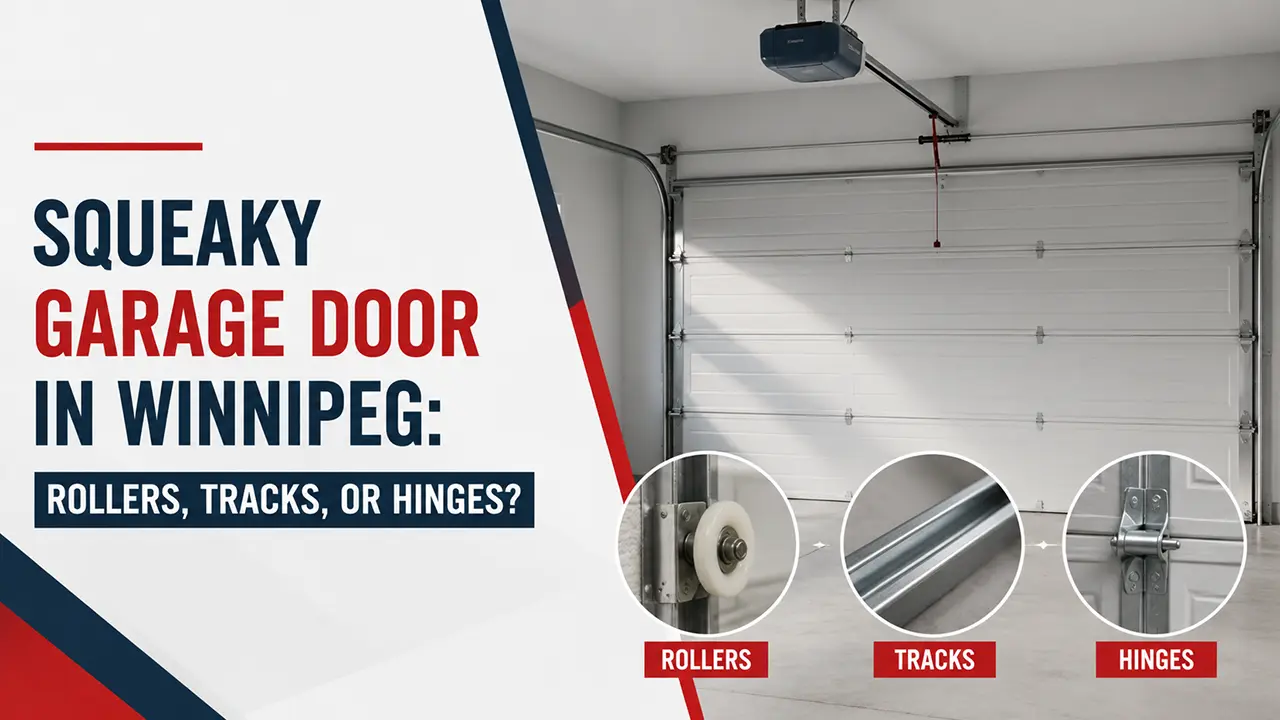
A squeaky garage door almost always comes down to one of three parts: dry or worn rollers, dry hinges, or a bent or dirty track. In Winnipeg, our winters make all three worse. Cold air stiffens old lubricant, frost brings surface rust, and road salt eats at the metal near the bottom of the door. The good news is that most squeaks are easy to trace once you know what each part sounds like. This guide walks you through how to find the source, what you can safely fix yourself, and when it is smarter to call a technician.
What your squeaky garage door is telling you
A squeak is friction. Two metal parts are rubbing where they should be gliding, or a moving part has lost its cushion of lubricant. On a sectional garage door, the parts that move every time you open and close are the rollers, the hinges, the springs, and the opener rail. When any of those dry out, wear down, or fall out of line, you hear it.
Here is the quick version before we get into detail:
- A high-pitched squeal that rises and falls as the door moves usually points to the rollers.
- A creak or groan right as the door bends around the curved part of the track usually points to the hinges.
- A grinding or scraping sound, sometimes with the door catching usually points to the track.
- A loud pop, bang, or heavy grinding is a different problem. That points to the springs, cables, or bearings, and it is not a DIY fix.
Why Winnipeg winters make garage doors squeak
If your door was quiet in July and started complaining in January, the weather is likely the reason.
Cold metal contracts. Parts that had a little breathing room in summer tighten up and start to rub in a deep freeze. On top of that, regular grease and old lubricant thicken and turn gummy once the temperature drops well below zero. A roller that spun freely in the fall now drags across the track because the lubricant on its bearing has gone sticky. That drag is what you hear as a squeal on a cold morning.
Frost and condensation add rust to the mix. Moisture settles on springs, hinges, and tracks overnight, then flash-freezes. Over a season that leaves a thin layer of surface rust that grinds and wears parts faster. Slush and road salt tracked in on your vehicle speed up corrosion at the bottom of the tracks and on the lowest rollers.
None of this means your door is failing. It usually means it is overdue for a clean and a proper cold-weather lubricant. Winnipeg doors need this more often than doors in milder climates.
How to find the source of the squeak
You do not need special tools. You need to close the door and listen carefully.
- Close the door and pull the release cord so the opener is disconnected, or unplug the opener at the wall.
- Lift the door slowly by hand about halfway and lower it. Do this a few times.
- Watch and listen for exactly where the noise starts.
Use this to match the sound to the part:
| What you hear | Where it happens | Most likely cause |
|---|---|---|
| High squeal that follows the door up and down | Along the vertical tracks | Dry or worn rollers |
| Creak or groan at one spot | At the curve where the door bends | Dry or loose hinges |
| Scrape or grind, door catches or jerks | Along the track, often one side | Bent, dirty, or loose track |
| Rattle or vibration | All over | Loose nuts, bolts, and brackets |
| Loud pop or bang | Near the top, above the door | Broken spring or cable (stop and call a pro) |
If the noise moves with the door, look at rollers. If it happens at one fixed point, look at hinges or a spot on the track.
Rollers: the most common cause of a squeal
Rollers are the small wheels on the edge of each panel that ride inside the tracks. Most squeals come from here, especially in winter.
Two things go wrong. First, the bearings inside the roller dry out, so the wheel drags instead of spinning. Second, older steel rollers wear down and grind, or their bearings seize. Nylon rollers run quieter and last longer, which is why many replacements switch to them.
A light spray of the right lubricant on the roller bearings often clears the noise straight away. If a roller is cracked, wobbling, or the wheel no longer turns freely, it needs to be replaced. That is a job worth handing to a technician, since a roller on the bottom bracket sits under cable tension and should not be pulled without care.
You can learn more about roller wear and replacement on our roller repair page.
Tracks: when the noise is a scrape or grind
The track is the metal channel the rollers run in. The track itself should not be squeaking, so when the noise comes from here it usually means one of a few things.
Debris and grit build up inside the channel and the rollers grind over it. A quick wipe with a dry cloth often solves this. A dent or bend in the track forces a roller to squeeze through a tight spot, which you hear as a scrape and feel as the door catching or jerking. Loose track brackets let the whole channel shift and rattle. And in Winnipeg, salt and moisture leave rust and pitting on the lower track that adds friction.
One important point: do not pack grease onto the face of the track. Grease on the track surface collects dust and dirt and turns into a paste that makes the problem worse. Keep the track clean and dry, and put the lubricant on the rollers, not the track face.
If a track is visibly bent, out of alignment, or pulling away from the wall, that needs proper adjustment. Forcing a door through a bad track damages the rollers and panels. Our track alignment service covers this.
Hinges: the creak as the door bends
Hinges connect the panels and let the door fold as it travels around the curved part of the track. When a hinge dries out, you get a creak or groan at that bending point, and it is often the loudest single squeak on the door.
Dry hinge pins are the usual cause, and a small amount of lubricant on each pivot point takes care of it. Loose hinge bolts can also rattle, so it is worth checking that each hinge is snug against the panel. If you see a hinge with an elongated or worn hole, or metal filings collecting under it, the hinge is wearing out and should be replaced before it cracks a panel.
What about the springs?
Above the door you will see the springs. These are under extreme tension and they store all the force needed to lift a heavy door. Dry spring coils can add a squeak, and a light mist of lubricant across the coils is fine.
Everything beyond that is off limits for DIY. Never try to adjust, loosen, or replace a spring or cable yourself. A spring that lets go carries enough force to cause serious injury. If you hear a loud bang, the door suddenly feels twice as heavy, or you see a gap in the spring coil, stop using the door and call a technician. This is exactly the kind of emergency our garage door repair team handles.
How to safely lubricate your garage door for Winnipeg weather
If your inspection points to dry rollers or hinges rather than a bent track or a spring, a proper lubrication is often the whole fix. Here is the safe order.
- Close the door and unplug the opener so it cannot start while you work.
- Wipe the tracks clean with a dry cloth. Clear out any grit, cobwebs, or salt residue. Do not lubricate the track face.
- Spray the hinge pivot points, one squirt at each hinge.
- Spray the roller bearings where the wheel meets the stem. Wipe away drips so nothing lands on the track face. Skip the nylon wheel itself if your rollers are nylon.
- Mist the springs, the bearings in the centre and end brackets, and the top pivot of the arm that connects the door to the opener.
- Lubricate the opener rail or chain according to the opener maker. A belt drive usually needs nothing.
- Plug the opener back in, run the door a few times, and wipe off any excess.
Doing this in the fall before the cold sets in makes a real difference in how quietly your door runs through winter.
What lubricant to use, and what to avoid
Use a garage-door-rated silicone or white lithium spray lubricant. These stay fluid in the cold and cling to the parts without collecting dust. This matters more in Winnipeg than almost anywhere, because a summer-weight grease can turn stiff and sticky once the temperature falls.
Avoid regular household oil and avoid using standard WD-40 as your main lubricant. The original blue-and-yellow can is a cleaner and penetrant, not a long-term lubricant. It can strip the grease off your parts and leave them drier than before. It is fine for loosening a stuck bolt, but follow up with a proper silicone or lithium product. Also skip thick automotive grease on any part of the door.
When to stop and call a professional
Lubrication solves a lot of squeaks. Some noises are telling you something more serious, and those are worth a call:
- The squeak comes back within days of lubricating.
- The door catches, jerks, or moves crookedly.
- You hear grinding, popping, or banging rather than a squeak.
- A roller is cracked or a wheel no longer turns.
- A track is bent, loose, or pulling off the wall.
- Anything to do with a spring or cable.
A technician can spot a worn part before it fails and leaves you with a door stuck open in the middle of a cold snap. Regular servicing also catches the small problems that a squeak is warning you about. Our maintenance service includes lubrication, alignment checks, and a full safety inspection.
How often should you lubricate a garage door in Winnipeg?
Twice a year is a good baseline for most homes. Because of our winters, the smart timing is once in the fall before the freeze and once in the spring after the salt and slush season. If your garage is unheated, your door works harder in the cold, so lean toward that fall service without fail. A door that gets used many times a day may need attention more often.
Frequently asked questions
Why does my garage door only squeak in winter?
Cold weather thickens old lubricant and contracts the metal parts, so rollers and hinges that ran smoothly in summer start to drag and rub. A clean and a fresh coat of cold-rated lubricant usually fixes it.
Can I use WD-40 on my garage door?
Standard WD-40 is a cleaner and penetrant, not a lasting lubricant. It can strip existing grease and leave parts drier. Use a silicone or white lithium spray made for garage doors instead, and save WD-40 for freeing a stuck bolt.
Should I lubricate the garage door tracks?
No. Keep the track clean and dry, and lubricate the rollers instead. Grease on the track face collects dirt and salt and makes the noise worse.
Is a squeaky garage door dangerous?
A simple dry squeak is not dangerous, but it is a sign your door needs care. Grinding, popping, or banging is different and can point to a failing spring or cable, which should be handled by a professional right away.
How much does it cost to fix a squeaky garage door in Winnipeg?
A lubrication and tune-up is inexpensive and often solves the problem. Costs rise if worn rollers, hinges, or a bent track need replacing. Ask for a free quote so you know the price before any work starts.
Get your Winnipeg garage door running quietly again
If your door keeps squeaking after a good lubrication, or the noise sounds more like grinding than a squeak, it is worth having someone look at it before a small problem turns into a stuck door. A1+ Door Systems is a family-run, BBB-accredited garage door company serving homes across Winnipeg, from the Kildonans to Fort Garry, St. Boniface, Transcona, and beyond.
Call or text us at (204) 404-3667 for same-day and 24/7 emergency service, or request a free quote online.