

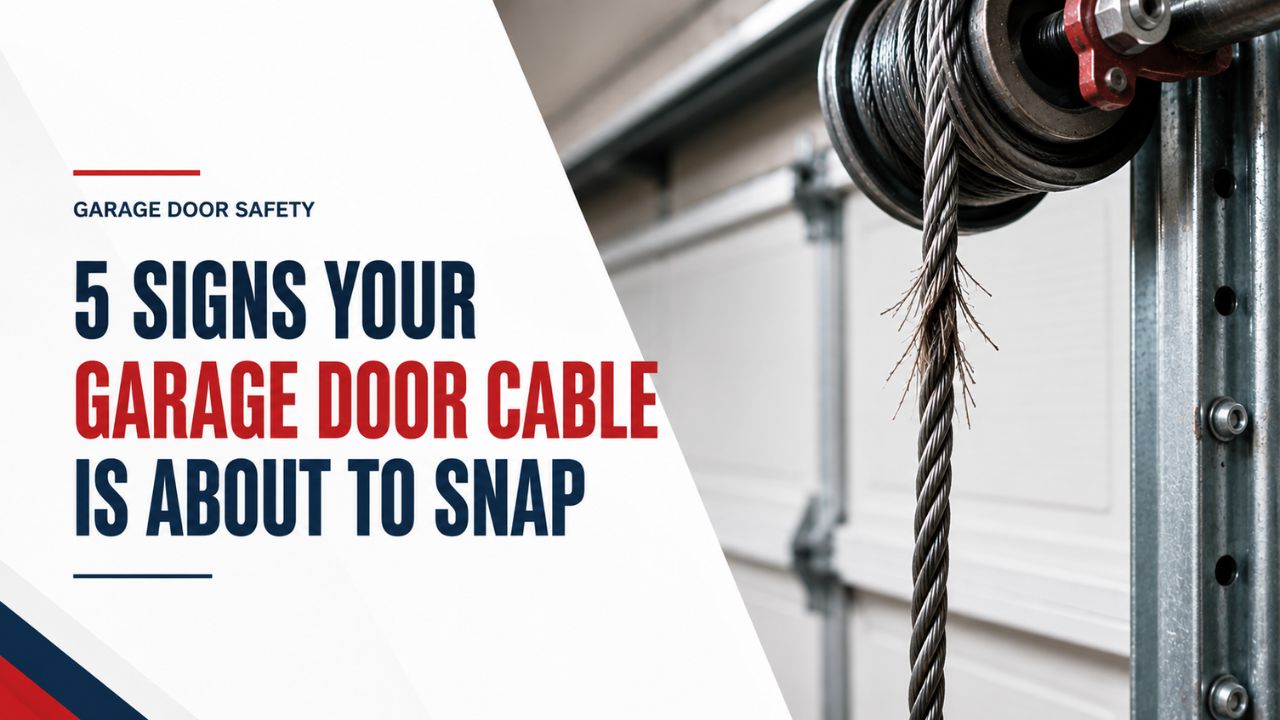
A garage door cable is about to snap when you notice one or more of five warning signs: frayed or broken strands sticking out of the cable, rust and corrosion along its length, a door that hangs crooked or sits lower on one side, a cable that has gone loose or slipped off its drum, and new grinding, popping or scraping sounds during operation. Each cable on your door helps hold a load that can weigh between 90 and 180 kilograms (200 to 400 pounds), and it works under constant tension alongside the springs. Catching these signs early is the difference between a quick, planned repair and a door that comes down without warning.
In Winnipeg, where road salt, freeze-thaw cycles and unheated back-lane garages are hard on steel hardware, cables often wear out faster than the manufacturer averages suggest. Here is what each warning sign looks like, and what to do the moment you spot one.
What is a garage door cable, and what does it do?
A garage door cable is a braided, aircraft-grade steel cable that connects the bottom of the door to the spring system and carries the door’s weight as it opens and closes. Most residential doors use two cables, one on each side, running from the bottom bracket up to a drum on a torsion system or a pulley on an extension system. Industry hardware specifications put the tensile strength of these cables at roughly 1,800 to 2,200 pounds (International Door Association figures), which is what lets a thin cable hold a heavy door in balance.
Because the cable shares the load with the springs, a worn cable puts extra strain on every other part, and a worn spring puts extra strain on the cable. That is why cable and spring problems so often show up together. If you are already seeing symptoms, our garage door cable repair and replacement service is the fastest way to get a straight answer.
One local note: in our climate the cable at the bottom of the door sits closest to the slush, salt and meltwater tracked in off the street, so it is usually the first component on the whole door to show corrosion.
Why do garage door cables snap in the first place?
Garage door cables snap because of a combination of age, tension fatigue, rust and stress from failing springs. A typical torsion system is rated for about 10,000 open-and-close cycles, which works out to roughly seven years for an average household and sooner for a busy one. Every cycle flexes the cable a little, and over thousands of cycles the individual steel strands begin to fatigue and break.
The most common causes we see on Winnipeg doors are:
- Normal wear and cycle fatigue from thousands of open-and-close cycles
- Rust and corrosion from moisture, road salt and calcium chloride
- A broken or weakening spring that dumps extra load onto the cable
- Track misalignment or debris that makes the cable rub and fray
- Cold-weather brittleness: steel loses ductility in deep cold, so a cable already weakened by rust is far likelier to let go during a minus 30 degree snap
Winnipeg’s freeze-thaw swings are unusually hard on cables. Water works into the strands during a thaw, then freezes and expands, and that constant expansion and contraction speeds up fraying. Add the salt and calcium chloride used on city streets and back lanes, and an unheated detached garage becomes a corrosion chamber for anything made of bare steel.
What are the 5 signs your garage door cable is about to snap?
The five clearest warning signs are:
- Frayed strands or “fishhooks” poking out of the cable
- Rust and corrosion along the cable and at the bottom bracket
- A garage door that hangs crooked or sits lower on one side
- A loose, slack or unwound cable, or one that has slipped off the drum
- New grinding, popping or scraping sounds and jerky movement
Quick reference:
| Warning sign | What you will notice | Urgency |
|---|---|---|
| Frayed strands / fishhooks | Sharp broken wires poking out; a section that looks thin or unravelled | Stop using the door |
| Rust and corrosion | Orange or brown flaking, a rough dry surface near the bottom bracket | Replace soon |
| Crooked or uneven door | Door sits lower on one side; uneven gap along the floor; binding | Repair promptly |
| Loose or unwound cable | Slack cable, sagging, or wire slipped off the drum when closed | Same-day repair |
| New grinding or popping | Scraping, banging, clicking, or jerky, hesitating movement | Inspect right away |
1. Frayed strands or “fishhooks” on the cable
A frayed cable is the single most reliable sign that failure is close. Garage door cables are made of many thin steel wires twisted together, and when those wires start to break they spring outward as sharp little burrs that technicians call fishhooks. With the door fully closed, run your eye (never your bare hand) along the length of each cable. If you see broken strands, a section that looks thinner or necked down, or wires unravelling near the bottom bracket or the drum, the cable has already lost much of its strength and can let go at any time. Fraying near the bottom bracket is especially common here because that is where salt and meltwater collect. Once you spot fishhooks, stop using the door and book a repair.
2. Rust and corrosion along the cable
Rust is both a warning sign and a cause. A rusted cable has lost cross-section and strength, and corrosion accelerates fraying by pitting the surface of each strand. Look for orange or brown discolouration, flaking, or a rough, dry texture instead of the smooth grey of a healthy cable. Pay close attention to the bottom few inches near the bracket and to any spot where the cable rests against hardware. In an unheated Winnipeg garage, condensation off a warm vehicle parked overnight, combined with road salt dripping from the car, creates near-perfect conditions for rust all winter. If the cable or the bottom bracket is visibly corroded, treat it as a component nearing the end of its life and worth a preventive maintenance visit.
3. Your garage door hangs crooked or uneven
If your closed door sits lower on one side, or the gap along the floor is uneven, one cable is likely stretching or slipping. The two cables are meant to lift the door in balance. When one begins to fail, that side drops and the door twists slightly in the tracks. You may also notice the door catching or binding on one side as it moves. A crooked door is more than a cosmetic problem: the imbalance strains the opener, the rollers and the remaining good cable, which can set off a chain of failures. Do not try to level the door by adjusting the cable yourself, because the tension involved is genuinely dangerous.
4. A loose, slack or unwound cable
A cable should stay taut through the full range of motion. If you see a cable hanging loose, sagging, or wound unevenly on the drum when the door is closed, it has either stretched, come off its drum, or lost tension because of a spring problem. Slack cable often points to a spring that is failing, since the two work as a system. A cable that has jumped off the drum can jam the door or let it drop suddenly. This is a same-day repair situation, not something to watch for a week. Leaving a door on a slack or derailed cable risks it coming down as dead weight.
5. New grinding, popping or scraping sounds
Garage doors tend to talk to you before they fail. A cable that is fraying, slipping or catching on hardware will often make new sounds: a grinding or scraping as strands drag, a sharp pop or bang as tension shifts, or a rhythmic clicking as a damaged section passes over the drum. Jerky, hesitating movement instead of a smooth glide is the matching symptom you can see. Because a cold Winnipeg morning already makes a healthy door a little louder and stiffer, focus on sounds that are new or getting worse rather than the usual winter creaks. New noise plus uneven movement is your cue to have the system inspected before something breaks.
What should you do if you notice these signs?
If you spot any of these warning signs, stop using the garage door and call a professional technician. A door with a failing cable can drop without warning, and the door itself can weigh between 90 and 180 kilograms (200 to 400 pounds). Do not park under it, and keep children and pets clear until it is repaired.
The most important rule is not to attempt the repair yourself. Garage door cables and springs store enormous energy under tension. The U.S. Consumer Product Safety Commission, which keeps the most complete North American injury data, estimates that garage doors are linked to 20,000 to 30,000 emergency-room visits a year, with spring and cable failures among the more serious categories. Most of those serious injuries happen during repair attempts, not normal use. A trained technician has the winding bars, clamps and correct replacement parts to swap a cable safely, and will replace both cables and check the springs at the same time so you are not back to square one in a month.
A1+ Door Systems offers same-day and 24/7 emergency service across Winnipeg, so a frayed or snapped cable does not have to leave your car trapped or your garage open overnight in the cold. You can request a free quote or emergency service here.
Can you replace a garage door cable yourself?
It is strongly discouraged. Replacing a cable means releasing and re-setting spring tension, and one slip can send a winding bar or spring end flying with enough force to break bones. That tension does not go away just because the cable has gone slack. For a system that can injure even a professional who rushes it, do-it-yourself is not worth the risk to save a modest repair cost. This is a job for a licensed technician with the right tools.
How long do garage door cables last?
Most garage door cables last about 8 to 15 years, but that range depends heavily on cycle count and climate. A cable rated for around 10,000 cycles will reach that number in roughly seven years for a family that opens the door four or five times a day, and sooner for a busy household. In a harsh climate like Winnipeg’s, salt and freeze-thaw exposure can shorten a cable’s usable life well before it hits its cycle rating. The International Door Association recommends a professional inspection at least once a year, which is the simplest way to catch a wearing cable before it snaps. Booking a tune-up in the fall, before the deep cold sets in, is good timing on the prairies.
How much does garage door cable replacement cost in Winnipeg?
Cable replacement is one of the more affordable garage door repairs. A straightforward job on a standard residential door commonly falls in the range of roughly $150 to $350 in Canada, though the exact price depends on your setup. Cost varies with the cable type (torsion versus extension), whether one or both cables are replaced (replacing both is standard practice), and whether the springs need attention at the same time. Because A1+ Door Systems partners directly with manufacturers and keeps common parts in stock, we can quote transparent pricing with no surprise fees. The most accurate way to know your number is a free, no-obligation quote.
Book a Winnipeg cable inspection or emergency repair
Spotted a fishhook, a patch of rust, or a door that is suddenly hanging crooked? Do not wait for the cable to give out on the coldest morning of the year. A1+ Door Systems is a family-owned Winnipeg company with more than two decades of experience and same-day, 24/7 emergency service. Call (204) 404-3667 or request a free quote, and we will have your door running safely again.
Frequently asked questions
Is it safe to use my garage door if the cable is frayed?
No. A frayed cable can snap at any time, and if it fails while the door is moving the door can drop or jam. Stop using the door and arrange a repair. A frayed cable rarely fixes itself and almost always gets worse.
Can one garage door cable snap while the other stays fine?
Yes. Cables can fail one at a time, and a door that sits crooked or lower on one side is a common early sign. Technicians replace both cables together, though, because the second is usually close behind the first and a matched pair keeps the door balanced.
Why do garage door cables rust faster in Winnipeg?
Road salt and calcium chloride, meltwater, and freeze-thaw cycles all speed up corrosion, and many Winnipeg garages are detached and unheated. A warm car parked overnight sheds salty slush and condensation onto the bottom of the door, right where the cable and bracket sit.
What happens if a garage door cable snaps completely?
The door loses balance and can slam shut, come off its tracks, or hang crooked and jammed. If a spring is involved, the door becomes dead weight of 90 to 180 kilograms. Keep clear of the door and call for emergency service.
How often should I have my garage door cables inspected?
At least once a year, in line with International Door Association guidance. In Winnipeg, a tune-up in the fall is smart timing, because it catches worn cables and weak springs before the coldest, hardest months on the hardware.
Does a broken spring affect the cable?
Yes. Springs and cables work as one system. A weak or broken spring puts extra load onto the cables, which accelerates fraying, and slack cable is often the first visible clue that a spring is on its way out.