

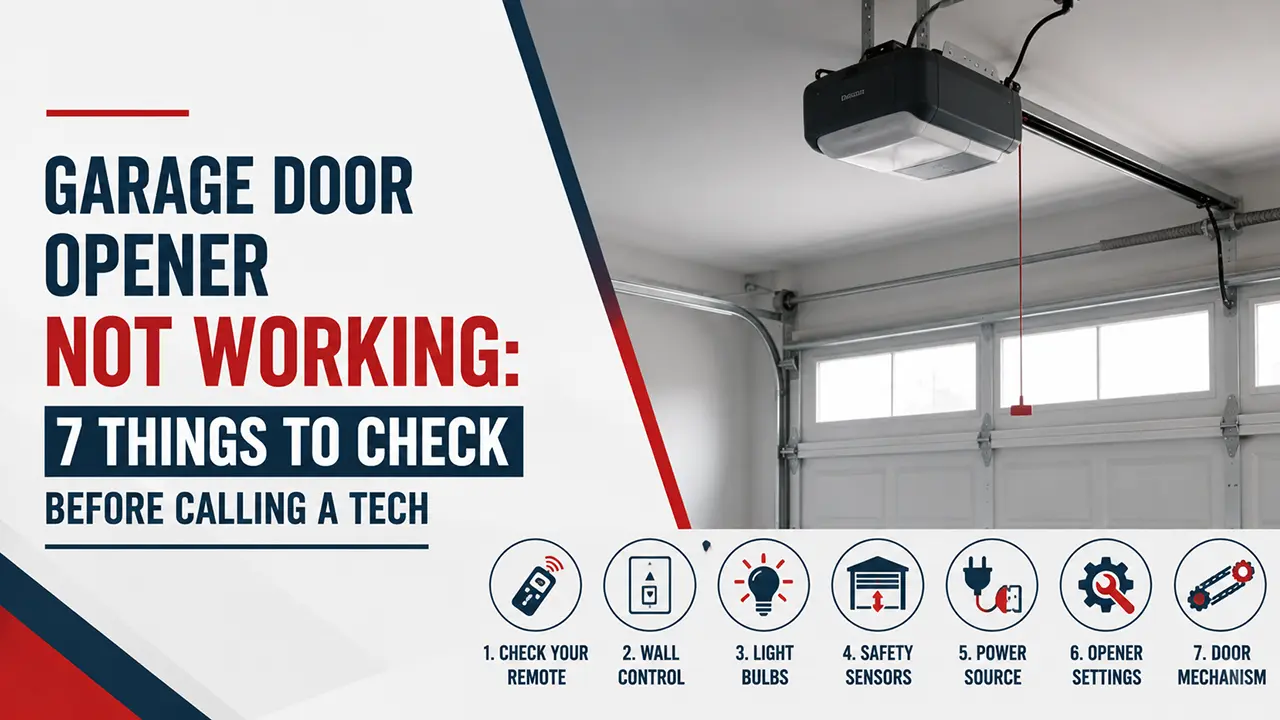
Most garage door opener problems come down to something simple: no power, a dead remote battery, a locked wall console, or misaligned safety sensors. You can check all of those in a few minutes, and often you will have the door working again without paying for a service call. Here are seven things to check, in order from easiest to most involved. If you get to the end and the opener still will not run, that is your sign to call a technician, and we will explain why.
Before you start, a safety note. These checks are all things a homeowner can do safely. None of them involve the springs or cables. If at any point the door feels very heavy, hangs crooked, or you hear a bang, stop and call a pro. Those are signs of a broken spring, not an opener fault.
1. Confirm the opener is getting power
It sounds obvious, but a surprising number of opener calls come down to power.
Check that the opener is plugged in fully. Cords work loose, and sometimes a plug gets knocked during storage or cleaning. Then check your electrical panel for a tripped breaker. Many garages also run the outlet on a GFCI, the kind with the reset button, and those trip on their own, especially in a cold or damp garage. Press the reset button on the outlet, or plug a phone charger or lamp into it to confirm it has power.
If the opener has no lights and makes no sound at all, power is the first thing to rule out.
2. Test the wall button against the remote
This one check tells you where the problem is.
Press the wall button inside the garage. If the door works from the wall button but not from your remote or keypad, the opener itself is fine and the problem is in the remote or keypad. If nothing works from the wall button either, the issue is with the opener or its power.
This simple test saves you from replacing remote batteries when the real problem is somewhere else.
3. Replace the remote and keypad batteries
If the wall button works but the remote does not, start with the battery. Remote and keypad batteries are cheap and they are the most common reason a remote quits.
Cold weather is hard on these batteries. Through a Winnipeg winter, a remote clipped to a visor or a keypad mounted outside can go flat much faster than it would in summer. Swap in a fresh battery before assuming the remote is broken. If a new battery does not fix it, the remote may need to be reprogrammed to the opener, which the manual explains, or it may simply be worn out and need replacing.
4. Make sure the opener is not locked
Most wall consoles have a lock or vacation mode. It is meant to stop remotes from working while you are away for security. It is also very easy to press by accident.
If your remotes suddenly stopped working all at once but the wall button still runs the door, look for a lock button on the wall console, often marked with a padlock symbol, and hold it to switch lock mode off. A blinking light on the wall console is a common sign that lock mode is on. This is one of the quickest fixes there is, and it is missed all the time.
5. Clean and realign the safety sensors
If your door starts to close and then stops or reverses back up, look at the safety sensors. These are the two small photo eyes mounted near the bottom of the tracks, one on each side. They shine an invisible beam across the opening, and if anything breaks that beam the door will not close. This is a safety feature that stops the door from closing on a person, pet, or vehicle.
Several things throw them off. Dirt, cobwebs, frost, or road grit on the lenses can block the beam. A bump from a car, a bike, or a snow shovel can knock one out of alignment. In winter, blowing snow and condensation are common culprits here.
Wipe both lenses clean with a soft cloth, then check that they point straight at each other. Most sensors have small indicator lights. When they are lined up and clear, the lights glow steady. When one is blocked or misaligned, a light usually blinks or goes out. Adjust the brackets gently until both lights are steady, and the door should close normally again.
6. Clear the door’s path and check the release cord
Two things to look at here.
First, look for anything blocking the door or the track. A stored item leaning against the door, an object in the track, or ice built up along the bottom in winter can stop the door and make the opener seem faulty.
Second, check the manual release. This is the red cord hanging from the opener rail. It disconnects the door from the opener so you can move the door by hand during a power cut. If someone pulled it, the opener motor will run but the door will not move, because the two are no longer connected. With the door fully closed, you can re-engage the trolley, usually by pulling the cord back toward the door or running the opener until it clicks back into place. Check your manual for the exact step. Do this with the door closed, never with it open, since a disconnected door can drop.
7. Look and listen for a bigger problem, then know when to stop
If you have worked through the first six checks and the opener still will not run the door properly, pay attention to what it is doing, because it points to a repair rather than a quick fix.
- The motor hums or runs but the door does not move, and the trolley is connected. This often means a broken spring, a stripped opener gear, or a failed part inside the motor. Do not keep pressing the button, as running the motor against a stuck door can burn it out.
- The door reverses every time before it closes, and the sensors are clean and aligned. This can be a travel or force setting that needs adjusting, which is a technician’s job.
- Grinding, clicking, or slow and jerky movement. These point to worn gears, a drive problem, or strain from another part of the door.
- A loud bang followed by the door not working. That is very likely a broken spring. Stop using the opener and call for repair.
At this point you have safely ruled out the common, simple causes. What is left involves the motor’s internal parts, the door’s balance, or its high-tension springs, and those are handled by a technician. Our garage door opener repair services all the major brands, including LiftMaster, Chamberlain, Genie, and other major brands. Our garage door repair team can check the springs and hardware at the same time.
A quick note on cold weather and openers
Winnipeg winters give openers a harder time than most. Cold drains remote and keypad batteries quickly. Frost and condensation settle on the safety sensors. Old grease on the door stiffens, so the opener has to work harder and may strain or reverse. And a door frozen to the slab can make a healthy opener look broken when the real problem is ice at the bottom. A twice-a-year tune-up keeps the door moving freely so the opener is not fighting a stiff door all winter.
Frequently asked questions
Why is my garage door opener not working even though it has power?
The most common reasons are a locked wall console, misaligned or dirty safety sensors, a disconnected manual release cord, or a dead remote battery. Test the wall button first. If the door works from the wall button but not the remote, the problem is the remote, not the opener.
Why does my garage door open but not close?
This is almost always the safety sensors. If the door starts down and reverses, or will not close and the opener light blinks, clean both sensor lenses and check that they line up so their indicator lights are steady. Snow, frost, and cobwebs are common causes in winter.
Why does my opener motor run but the door does not move?
Either the manual release cord has been pulled, so the opener is disconnected from the door, or a spring or opener gear has failed. If the release is engaged and the door still will not move, stop running the motor and call a technician, as it is likely a broken spring.
Do garage door remotes stop working in cold weather?
Cold does not break a remote, but it drains the battery much faster. If your remote gets weak or unreliable in winter, a fresh battery is usually the fix. Keypads mounted outside are especially prone to this.
When should I call a technician for my garage door opener?
Call once you have checked power, the wall button, batteries, lock mode, the sensors, and the release cord and the opener still will not run the door. Also call right away for a loud bang, a humming motor that will not move the door, grinding noises, or any sign of a broken spring.
Still not working? We can help
If you have run through these checks and your opener still will not cooperate, the problem is usually inside the motor or tied to the door’s springs, and that is where a technician saves you time and keeps things safe. A1+ Door Systems is a family-run, BBB-accredited garage door company serving homes across Winnipeg, from the Kildonans to Fort Garry, St. Boniface, Transcona, and beyond. We repair and replace all major opener brands and check the whole door while we are there.
Call or text us at (204) 404-3667 for same-day and 24/7 emergency service, or request a free quote online.