

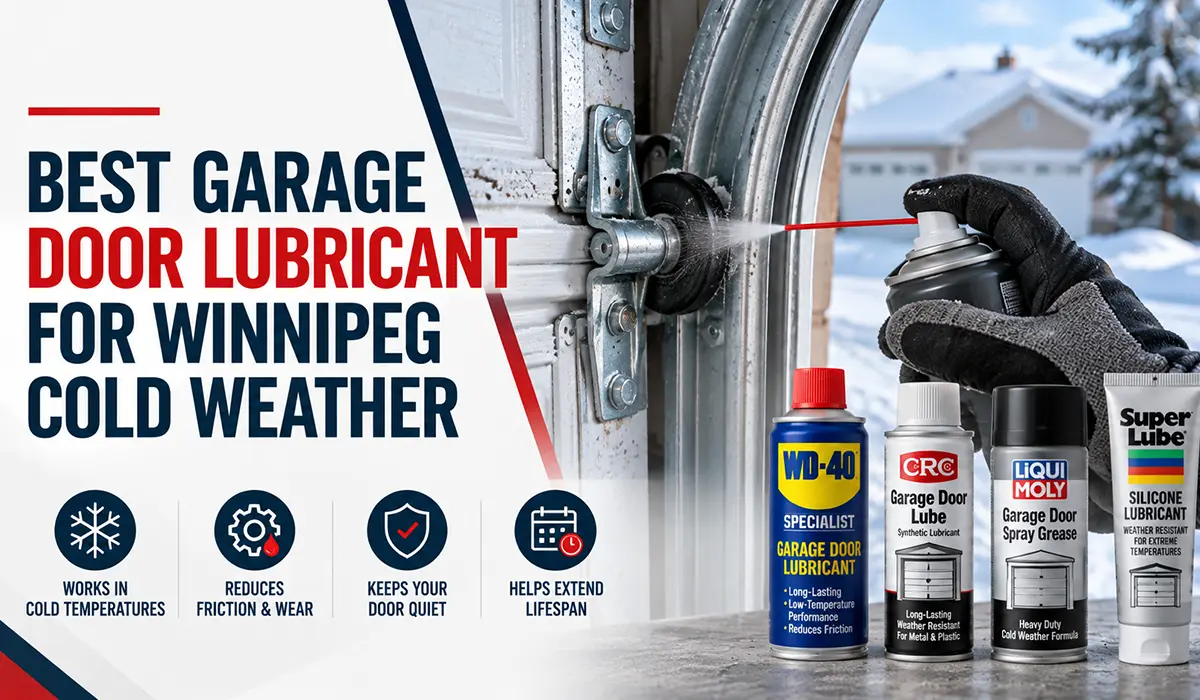
The best garage door lubricant for Winnipeg is a silicone-based spray or a white lithium grease spray made for garage doors and rated for very low temperatures. Regular WD-40 is not the right choice because it is a thin, solvent-based product that evaporates, attracts dust, and can strip the grease already on your hardware. Apply the right lube twice a year, with the first round in October before the deep freeze.
Why Winnipeg Winters Are Hard on Garage Door Lubricant
Winnipeg winters regularly drop to -30°C or colder. Most hardware oils and greases thicken in that kind of cold. Thick lubricant makes rollers, hinges, and springs work harder, and the opener has to push through that extra drag.
Road salt, slush, and freeze-thaw cycles add to the problem. Moisture gets into hinges and roller bearings, then freezes. A door that ran quietly in September can start groaning by December.
That is why lubricant choice matters more here than in a mild climate. If the product you use stiffens at -25°C, the door will feel it on the first cold morning.
Why WD-40 Is Not the Best Garage Door Lubricant
The classic blue and yellow WD-40 can is a water displacer and light penetrating oil. It is good at loosening rusty bolts and driving moisture out of parts. It is not designed to be a long-lasting lubricant.
Here is what goes wrong when it is used on a garage door:
- It does not last. The thin solvent carrier evaporates and leaves very little lubrication behind. The squeak often returns within weeks.
- It attracts dust and grit. A tacky film on tracks and rollers collects dirt, which wears parts faster.
- It can wash out the good grease. Spraying it on a hinge or bearing that already has grease can thin or flush that grease away.
- It does not hold up well in deep cold. Lighter oils lose their protective film quickly when parts cycle through freezing and thawing.
One fair note: WD-40 also sells a separate “Specialist” garage door product, which is a white lithium grease spray. That is a real garage door lubricant. The problem is the regular multi-use can, not every product with the WD-40 name. Always read the label.
Best Garage Door Lubricants for Cold Weather
Two types work well for Winnipeg. Which one you pick depends on the part.
| Lubricant type | Best for | Cold weather performance | Watch out for |
|---|---|---|---|
| Silicone spray | Hinges, roller stems, weatherstripping, springs, bearing plates | Stays fluid at very low temperatures and does not attract much dust | Can wear off faster on heavily loaded metal parts |
| White lithium grease spray | Metal-on-metal parts, bearing plates, opener chain and screw | Clings well and lasts longer, but cheap versions can stiffen in deep cold | Check the label for a low-temperature rating |
| Regular WD-40 | Loosening rusted bolts only | Poor | Not a lasting lubricant, collects dirt |
| Heavy multi-purpose grease | Nothing on a residential door | Poor, gets stiff | Gums up and slows the door |
Our pick for most Winnipeg homes: a garage door lubricant that is silicone-based or a light white lithium spray with a clearly stated cold rating. Products sold specifically as garage door lube, such as 3-IN-ONE Garage Door Lubricant or the WD-40 Specialist garage door formula, are easy to find at hardware stores. Formulas change, so check that the current label says it works in low temperatures before you buy.
What to look for on the label:
- The words “garage door” on the can
- A low-temperature rating (the colder the better, since we see -30°C and below)
- A straw or nozzle for precise spraying
- Silicone or white lithium listed as the main type
What to Lubricate on Your Garage Door
Spray a light coat on these moving parts:
- Hinges. Put a small amount on each hinge pivot point.
- Roller stems. Spray where the roller stem meets the bearing. Steel rollers and nylon rollers both benefit.
- Torsion spring coils. Use a light spray along the coils to cut down squeaking. Do not touch the winding cones or adjust anything.
- Bearing plates. These sit at both ends of the torsion bar and take a lot of load.
- Center lock and side locks. A short spray keeps them moving in the cold.
- Opener chain or screw. Use a lubricant labelled for your opener type. Check your manual first.
- Rubber weatherstripping. Silicone spray only. It helps stop the seal from freezing to the concrete.
What You Should Not Lubricate
This list matters as much as the first one.
- The inside of the tracks. Grease collects dust and debris, and rollers can start sliding instead of rolling. Wipe tracks clean with a dry cloth instead.
- Belt-drive openers. Belts run dry. Lube can damage them.
- Photo-eye sensors. Keep spray away from the lenses.
- Lift cables and bottom brackets. These are under very high tension. Leave them to a technician.
- Rubber seals with petroleum products. Petroleum can dry out and crack rubber. Use silicone.
Safety reminder: Garage door springs and cables hold enough force to cause serious injury. You can lightly spray the spring coils from a safe distance, but never loosen, adjust, or remove spring or cable hardware yourself. If you see rust, fraying, or gaps in a spring, book a spring repair or cable repair instead of lubricating around the problem.
How to Lubricate Your Garage Door: 7 Steps
- Close the door and make sure the opener cannot be triggered by a family member mid-job. Unplug it if you can reach the plug safely.
- Wipe the tracks with a dry or slightly damp cloth to remove dirt, old grease, and salt residue.
- Spray each hinge with one short burst at the pivot point.
- Spray the roller stems and bearings. Skip the track surface.
- Apply a light coat to the spring coils and bearing plates.
- Wipe off the extra. Drips attract dirt and can stain the floor or your car.
- Run the door up and down three or four times to spread the lubricant, then listen for squeaks or scraping.
Work in the afternoon on a milder day if you can. Lubricant spreads and bonds better when the hardware is not frozen. If it is bitterly cold, let the garage warm up a bit first.
How Often Should You Lubricate a Garage Door in Winnipeg?
Twice a year is the right schedule for Manitoba.
- October: Before the first real freeze. This is the most useful timing of the year.
- April or May: After the spring melt, when salt and moisture have done their damage.
If your door is used many times a day, or if your garage is not insulated, add a quick mid-winter check. A door that rises slowly, shakes, or makes new sounds needs attention sooner.
Most springs on Canadian doors are rated for around 10,000 cycles. Proper lubrication reduces friction and strain, which helps the whole system last. You can read more in our guide on how long garage door springs last in Winnipeg’s cold climate.
When Lubricant Is Not the Fix
Lubricant solves friction. It does not solve damage. If you still have problems after lubricating, one of these may be the cause:
- Persistent squeaking or grinding: Worn rollers or bent hinges. See our guide to a squeaky garage door in Winnipeg or book roller repair.
- Door shakes or looks uneven: Tracks may be out of alignment. See track alignment.
- Door will not open or close: Review why your garage door is not opening or closing in Winnipeg.
- Opener hums but does not lift: Check our list of 7 things to check when your opener is not working, or request opener repair.
- Door has come off the track: Stop using it. Read garage door off track in Winnipeg: DIY fix or call a pro.
- Frayed or rusty cable: Review the 5 signs your garage door cable is about to snap.
For a full overview, see the complete guide to garage door problems in Winnipeg.
Get a Professional Winter Tune-Up in Winnipeg
DIY lubrication is a good habit. A full tune-up covers more. During our garage door maintenance visit, a technician lubricates rollers and hinges, checks spring tension, tightens hardware, tests the opener and safety reverse, realigns tracks if needed, and inspects cables for fraying. We also catch worn parts before they fail on a -30°C morning.
A1+ Door Systems is a family-owned Winnipeg company with licensed and insured technicians and 24/7 emergency service. Our Winter Tune-Up is currently listed at $44.99 for a limited time (conditions apply). Book your tune-up or call (204) 404-3667.
If a part is already broken, our garage door repair team offers same-day service whenever possible.
FAQs
What is the best lubricant for a garage door in cold weather?
A silicone-based spray or a white lithium grease spray made for garage doors and rated for low temperatures. Apply it to hinges, roller stems, spring coils, and bearing plates.
Is WD-40 bad for garage doors?
The regular multi-use WD-40 is a poor choice. It evaporates quickly, attracts dust, and can remove existing grease. It works for loosening rusty bolts but not as a lasting lubricant.
Is silicone spray or white lithium grease better for a garage door?
Silicone stays fluid in deep cold and is safe for rubber seals. White lithium grease lasts longer on metal-on-metal parts. Many homeowners use both on different parts.
How often should I lubricate my garage door in Winnipeg?
Twice a year. Do it in October before winter and again in spring after the melt.
Should I lubricate garage door tracks?
No. Wipe them clean instead. Grease on the track collects dirt and can make the rollers slide.
Can I use WD-40 on a garage door opener chain?
Use a lubricant made for opener chains or the type your opener manual recommends. Belt-drive openers should not be lubricated.
Can I lubricate a garage door spring myself?
You can lightly spray the coils from a safe distance. Do not adjust, loosen, or remove springs or cables. Those jobs belong to a trained technician.
Why is my garage door still loud after lubricating it?
The rollers, hinges, or tracks may be worn or misaligned. Lubricant cannot fix damaged parts.