

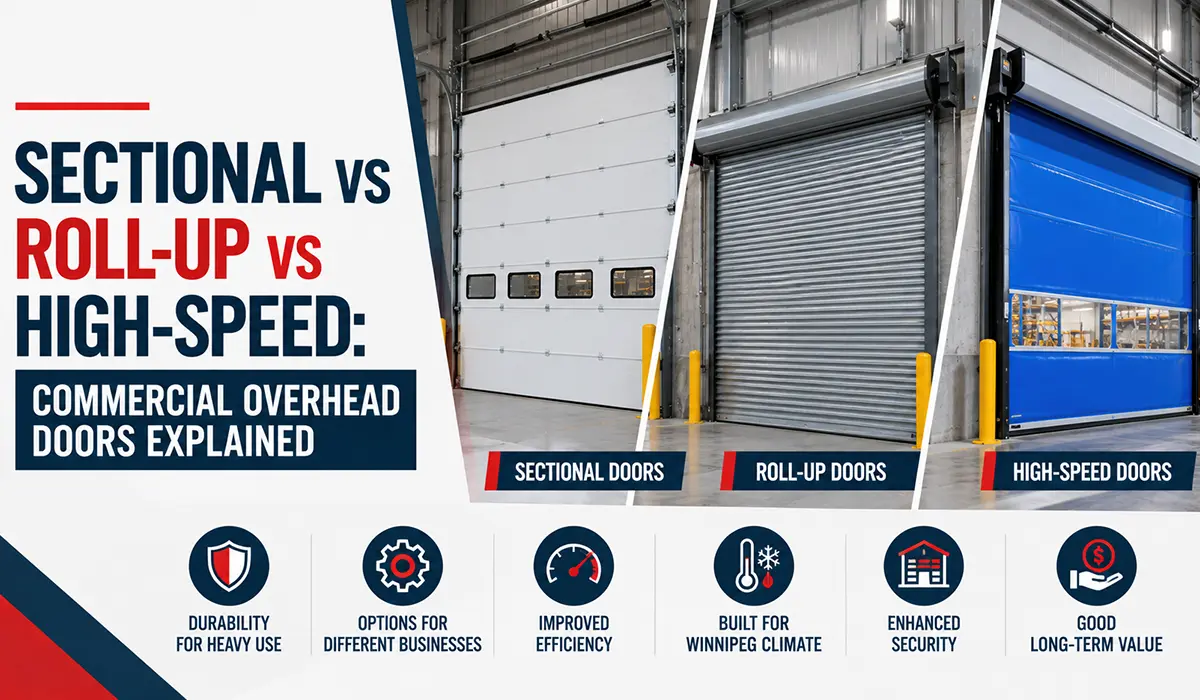
A sectional door is the best all-round choice for most Winnipeg businesses because it insulates well and suits most openings. A roll-up (rolling steel) door is best for security, durability, and tight spaces. A high-speed door is best where doors open all day and you need to hold heat in or keep traffic moving, such as warehouses, food plants, and cold storage. Your choice should come down to how often the door cycles, how much heat you need to keep, how much security you need, and how much space you have.
Why the Right Commercial Door Matters
A commercial door is not just an entrance. It affects your heating bill, your security, how fast trucks and forklifts move, and how often work stops for a repair. A door that is wrong for the job can cost more every month than the price gap between door types.
Winnipeg adds more pressure. Cold of -30°C and below, wind, snow, and road salt hit commercial doors hard. Doors that open dozens of times a day wear faster than any home door. Pick a type that handles your traffic and your climate.
The Three Main Types of Commercial Overhead Doors
1. Sectional overhead doors
A sectional door is made of horizontal panels joined by hinges. The panels roll up on tracks and curve back along the ceiling. Springs balance the weight so an operator can lift it. This is the same basic design used on homes, built heavier for commercial use.
- Best for: warehouses, shops, loading docks, fleet garages, storage buildings, retail back doors
- Strengths: strong insulation options, wide range of sizes, window options, easy to replace a single damaged panel, familiar service and parts
- Trade-offs: needs headroom above the opening for tracks and springs, moderate opening speed, panels can dent from impacts
2. Roll-up (rolling steel) doors
A roll-up door is a curtain of interlocking steel slats. It winds around a barrel at the top of the opening. It needs very little room, because it coils instead of running back along the ceiling.
- Best for: storefronts, loading bays with limited ceiling space, parking garages, warehouses, and places that need strong security
- Strengths: very tough and hard to break through, compact, long service life, can be operated by hand chain or motor, available in fire-rated versions where code requires them
- Trade-offs: standard slats insulate poorly, can be noisy, slower to open, a bad fit if you want windows or a polished look
For storefront protection, also see our Pentagon security shutters page.
3. High-speed doors
A high-speed door opens and closes much faster than other types, often in a couple of seconds. Most use a flexible fabric panel, and some use rigid panels. They are built for heavy daily use and for places where the opening must not stay open long.
- Best for: temperature-controlled spaces, cold storage, food and beverage plants, manufacturing, busy forklift routes, and interior doors between zones
- Strengths: cuts heat loss and air exchange, speeds up traffic, reduces dust and drafts, built for very high cycle counts
- Trade-offs: higher cost, less security than steel, lower insulation unless you choose an insulated model, needs sensors and controls, exterior use needs a model rated for wind
Sectional vs Roll-Up vs High-Speed: Side-by-Side Comparison
| Factor | Sectional | Roll-up (rolling steel) | High-speed |
|---|---|---|---|
| How it works | Hinged panels on tracks | Steel slats coil around a barrel | Fast-moving fabric or rigid panel |
| Speed | Moderate | Slow to moderate | Very fast |
| Insulation | Good with insulated panels | Poor unless insulated slats are used | Fair to good depending on the model |
| Security | Good | Excellent | Fair |
| Headroom needed | More | Least | Varies by model |
| Best use | General warehouse, shop, dock | Storefront, security, tight space | High traffic and temperature control |
| Durability | Strong, panels can be replaced | Very strong | Built for high cycles, fabric needs checks |
| Cost | Mid range | Mid to higher depending on size and rating | Usually the highest upfront |
| Windows | Available | Not usual | Vision panels on many models |
How to Choose: 7 Questions to Ask
- How often will the door open each day? A door that opens 5 times a day and one that opens 200 times are different jobs. Heavy use points to high-speed or high-cycle hardware.
- How much heat do you need to keep? If you heat or cool the space, insulation and open time matter. Think sectional with insulated panels or a high-speed door.
- How much security do you need? For storefronts and high-risk spots, a rolling steel door is hard to beat.
- How much space do you have? Measure headroom, sideroom, and backroom. Tight ceilings often point to roll-up.
- Is it an exterior or interior door? Exterior doors face wind, snow, and temperature swings. Check wind ratings and weather seals.
- Do fire or building codes apply? Some openings need a fire-rated door. Confirm requirements before you buy.
- What is your downtime tolerance? If a stuck door stops your business, plan for parts, service, and a maintenance schedule.
Which Door for Which Business?
| Business or space | Good first choice | Why |
|---|---|---|
| Warehouse loading dock | Insulated sectional | Good insulation, sizes to suit dock openings |
| Fleet or shop garage | Sectional | Easy to service, panels replaceable |
| Storefront or retail | Roll-up or security shutter | Security and compact space |
| Cold storage or food plant | High-speed insulated | Holds temperature, fast traffic |
| Busy forklift route inside a building | High-speed | Fast cycles, less waiting |
| Storage unit or low-use shed | Basic sectional or roll-up | Lower cost for light use |
| Parking garage | Roll-up or sectional | Durable and easy to secure |
These are starting points only. The right answer depends on your opening, your traffic, and your building. Request a free quote and tell us about your space.
Winnipeg Climate: What to Plan For
- Insulation. Heating bills in a Winnipeg winter are high. Ask for the R-value on insulated doors and check how well the seals close.
- Seals. Worn bottom and side seals let in cold air and snow. Inspect them each fall.
- Wind. Exterior doors in open lots take strong wind. Ask about wind ratings, especially for fabric high-speed doors.
- Cold-stiff parts. Springs, cables, and lubricants all work harder in deep cold. See how long garage door springs last in Winnipeg’s cold climate.
- Frost and ice. Ice at the bottom seal can freeze a door to the ground. Keep the threshold clear.
- Road salt. Corrosion hits bottom brackets, hinges, and tracks. Look for galvanized or coated parts.
Springs, Cycles, and Hardware
Most home door springs are rated for about 10,000 cycles. Commercial doors often need high-cycle springs rated for far more. A door that opens 50 times a day can use up 10,000 cycles in about seven months. Ask what cycle rating the springs have and match it to your real use. Poor spring selection is a common reason commercial doors fail early.
Do not service springs, cables, or bottom brackets yourself. Commercial doors are heavy and the tension is extreme. See our spring repair and replacement and cable repair and replacement pages.
Operators and Controls
Commercial doors can use trolley, jackshaft, or other motor operators, and many can also run on a hand chain or crank. Think about how the door will be controlled: wall button, key switch, radio remote, loop detector, motion sensor, or access control. Add safety edges and photo eyes for pedestrian and forklift traffic. If your operator is acting up, see our garage door opener repair page and our openers overview.
Maintenance for Commercial Doors
Commercial doors work harder than home doors, so they need a service plan, not just repairs. A typical commercial maintenance visit includes:
- Checking and balancing the springs
- Inspecting cables, drums, and bottom brackets
- Checking rollers, hinges, and track alignment
- Testing safety edges, photo eyes, and auto-reverse
- Lubricating moving parts
- Checking seals and weatherstripping
- Reviewing opener settings and limits
Busy doors may need more frequent visits than the twice-yearly schedule used for homes. Ask for a schedule based on your cycle count. See our garage door maintenance page, and watch for the warning signs in 5 signs your garage door cable is about to snap.
Replace or Repair?
Repair makes sense when the problem is a single part, like a spring, cable, roller, or damaged panel. Replacement makes sense when the door is old, the same problems keep returning, the parts are hard to find, or your needs have changed. A move from a basic door to an insulated or high-speed door may pay back in lower energy use and less downtime. See our garage door repair and garage door installation pages.
How A1+ Door Systems Can Help
A1+ Door Systems is a family-owned Winnipeg company that installs, repairs, and maintains commercial overhead doors for businesses, with 24/7 emergency service. Our site lists partners such as Richards-Wilcox and Midland. Tell us your opening size, how often the door runs, and whether the space is heated. We will recommend a system that fits, and tell you if your job needs something outside what we offer.
Need a quote or a service plan? Request service or call (204) 404-3667.
FAQs
What is the difference between sectional, roll-up, and high-speed doors?
A sectional door has hinged panels that run on tracks. A roll-up door is made of steel slats that coil around a barrel. A high-speed door uses a fast-moving fabric or rigid panel built for very frequent use.
Which commercial overhead door is best for a warehouse?
An insulated sectional door is the most common choice. For busy interior routes or temperature control, a high-speed door may suit better.
Which commercial door is most secure?
A rolling steel door is generally the most secure of the three because of its heavy interlocking slats.
Are high-speed doors worth the cost?
They can be, when doors open often or the space must hold temperature. They cut air exchange and speed up traffic. For low-use openings, a sectional door usually costs less overall.
Are roll-up doors insulated?
Standard rolling steel doors are not well insulated. Insulated slat versions exist, but a sectional door with insulated panels generally holds heat better.
How long do commercial overhead doors last?
It depends on the type, use, and maintenance. Springs, cables, and seals wear first. Regular service extends the life of the whole system.
How often should commercial overhead doors be serviced?
At least twice a year. Doors with heavy daily use may need more frequent service, based on the number of cycles.
Do I need a fire-rated door?
Some openings do, depending on building and fire codes. Check with your building or code authority before choosing a door.